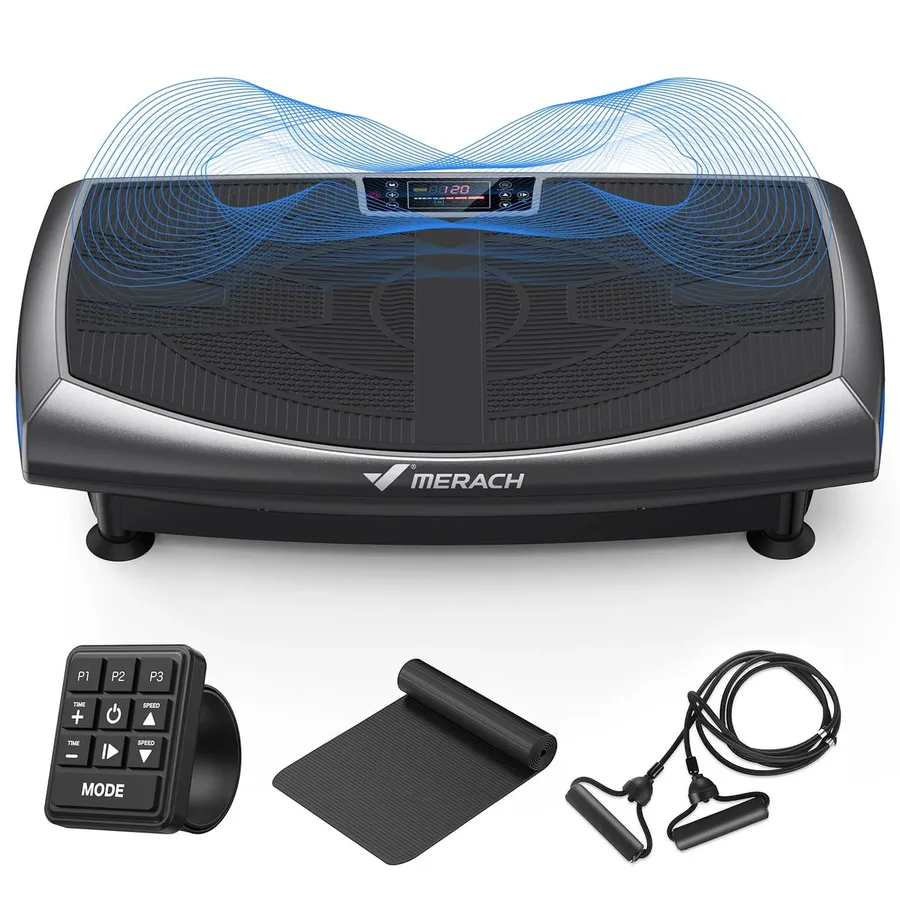
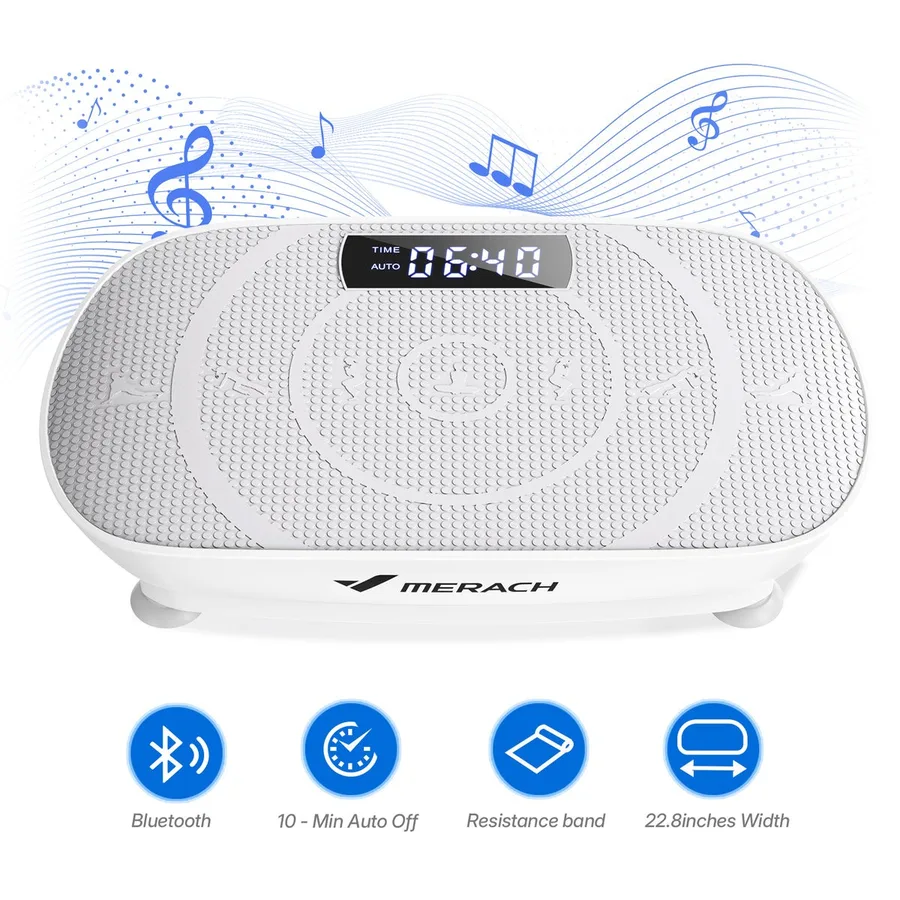
Which Merach vibration plate should you buy?
For most homes, the CV30 Pro. It does the classic seesaw motion well, starts when you step on and costs about $100 during the sale. Move up to the CV40 if you are over 6 ft or close to 400 lb, because its deck is 5.5 inches longer and its rating 40 lb higher.
Pick a 4D plate, the CV55 or the CV61, if you want to change the type of motion during a session. Our CV30 Pro vs CV40 and CV30 vs CV30 Pro pages go into the fine print.
Oscillating or 4D: what actually changes?
The CV30, CV30 Pro and CV40 are oscillating plates: the deck rocks left and right like a seesaw between 7 and 9.6 Hz, and the amplitude, how far each side travels, is the number that matters. 13 mm on the CV40, 11 mm on the CV30 pair.
The CV55 and CV61 use three motors to add a side-to-side shift and a pulse on top of the seesaw, across 120 speed steps. That gives you more ways to use the plate. It does not make it stronger: the CV55 lists 10 mm and the CV61 11 mm.
Before your first session
Merach prints a safety warning on every plate listing. If you are pregnant, have a pacemaker or another implant, or live with a medical condition, ask your doctor before you use any vibration plate. Start at a low speed, keep your knees soft and stop if anything feels wrong.
New to plates? Our guide on how to use a Merach vibration plate covers stance, the remote and the first week. Lost the remote? See the Merach remote guide.
The model numbers on the box
Merach plates also carry factory codes, which is what many marketplace titles and manuals use. MR-2398 is the CV30 Pro family, MR-2440 the CV40, MR-2515 the CV55, and MR-2489 or MR-2490 the CV61. Our Merach model number guide matches every code to its name.
Where the order comes from
The order above is the score order, nothing else: one formula for every machine in this category, fed by the merachfit.com spec table and the price we logged. Weights and anchor values are listed on our scoring page.